It didn’t explode overnight. It unraveled slowly, quietly—like a thread being pulled from a sweater until the whole thing lost its shape. When my husband finally left, he didn’t just walk out on me. He walked away from our children, from the life we had built, from the responsibility we once shared.
And just like that, I became everything.
I was the one who earned the money, fixed the broken sink, checked homework, paid bills, soothed nightmares, and held the house together when it felt like it might collapse. There were nights I cried after everyone went to sleep, sitting alone in the kitchen, wondering how I would stretch one more paycheck. There were mornings I stood in front of the mirror and told myself to be strong even when I felt anything but.
Over time, the pain changed shape. It didn’t disappear, but it hardened into something steady. I built a life from scratch. A small but peaceful life. A life where I no longer waited for someone to rescue me.
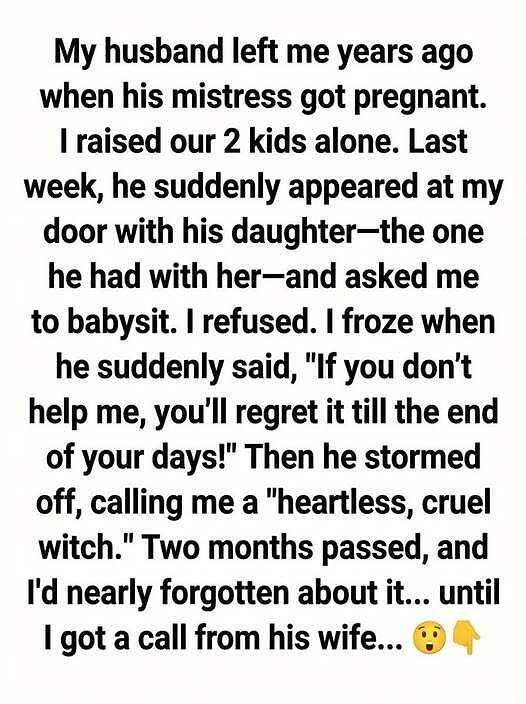
And then one Tuesday afternoon, there was a knock at my door.
I opened it—and there he was.
He looked comfortable. Confident. As if time had smoothed everything over.
Next to him stood a little girl, maybe four years old. His daughter. A child from the new life he had created while I was rebuilding ours alone.
There was no apology. No acknowledgment of the years he had missed. No recognition of the weight I had carried.
Instead, he asked if I could watch his daughter for a few hours.
He spoke casually about a scheduling conflict. A last-minute emergency. As if I were still available. As if I were simply an extension of his convenience.
I looked at the little girl. She was innocent. None of this was her fault. I felt a small ache for her.
But I also felt something else—clarity.
I told him no.
Calmly. Clearly.
I wasn’t angry. I wasn’t cruel. I just wasn’t available.
His expression changed instantly. The polite tone disappeared. He accused me of being bitter. Of punishing a child. Of holding onto the past.
But beneath his anger, I saw the real issue. He wasn’t upset about the child. He was upset that I wasn’t the woman he used to know—the one who would bend, sacrifice, smooth things over, and carry the burden quietly.
That woman no longer existed.
I closed the door while he was still talking. My hands shook—not from fear, but from the shock of seeing how little he had changed.
Afterward, I sat down in silence. Doubt tried to creep in. Had I been too harsh? Was I being selfish? Should I have helped just for the child’s sake?
For years, I had been taught to be the “bigger person.” To absorb discomfort. To nurture, no matter the cost.
But as the house grew quiet, another truth settled in. Being the bigger person had often meant abandoning myself.
No one had stepped in when I was drowning. No one had carried my responsibilities when he left. I had rebuilt my life piece by piece. I had fought for stability, for peace, for dignity.
I wasn’t obligated to offer my labor just because we once shared a history.
A few weeks later, my phone rang. I expected another argument.
Instead, it was his new wife.
Her voice was hesitant but sincere. She apologized. She didn’t excuse his behavior. She admitted it was unfair to expect anything from me. She said I owed them nothing.
I didn’t expect that call. And I didn’t need it to feel justified. But it confirmed something important.
My boundary wasn’t cruel. It was necessary.
I could feel compassion for that little girl without sacrificing myself. I could acknowledge the past without reopening it.
That afternoon became a turning point. Not because of the confrontation—but because I didn’t collapse under it.
Today, my home feels calm. The children I raised are growing into strong, thoughtful people. The chaos that once defined my life has faded into memory.
I don’t replay that moment with regret anymore. I see it clearly now.
It was the day I realized that strength doesn’t have to shout.
Sometimes it’s just a quiet, steady no.
And sometimes, protecting your peace is the bravest thing you can do.

